Framework Design Guidelines: Conventions, Idioms, and Patterns for Reusable .NET Libraries (2nd Edition)

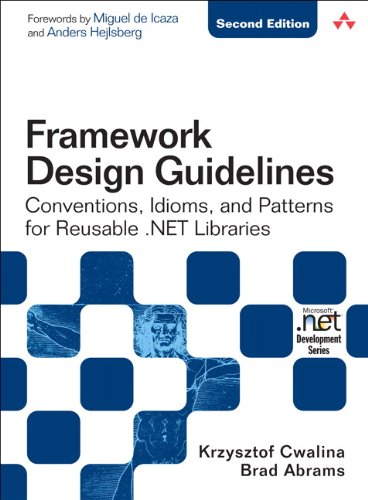
Framework Design Guidelines: Conventions, Idioms, and Patterns for Reusable .NET Libraries (2nd Edition) is a product to be taken into possession. Because there is very useful in applications. And it's a reasonable price. Not too expensive. Framework Design Guidelines: Conventions, Idioms, and Patterns for Reusable .NET Libraries (2nd Edition) can be purchased from the Internet. After Framework Design Guidelines: Conventions, Idioms, and Patterns for Reusable .NET Libraries (2nd Edition) was purchased. Products are delivered quickly. It makes our family very happy after work. It is very easy to use. The installation is easy because Framework Design Guidelines: Conventions, Idioms, and Patterns for Reusable .NET Libraries (2nd Edition) is easy to read and understand the information they love Framework Design Guidelines: Conventions, Idioms, and Patterns for Reusable .NET Libraries (2nd Edition) so much. We have recommended that we buy it all. If you are looking for a similar product that I recommend. Because the price is not too expensive. One. Framework Design Guidelines: Conventions, Idioms, and Patterns for Reusable .NET Libraries (2nd Edition) has a price. And limited.Framework Design Guidelines: Conventions, Idioms, and Patterns for Reusable .NET Libraries (2nd Edition)

Framework Design Guidelines: Conventions, Idioms, and Patterns for Reusable .NET Libraries (2nd Edition) Overview
This is the eBook version of the printed book.
Framework Design Guidelines, Second Edition, teaches developers the best practices for designing reusable libraries for the Microsoft .NET Framework. Expanded and updated for .NET 3.5, this new edition focuses on the design issues that directly affect the programmability of a class library, specifically its publicly accessible APIs.
This book can improve the work of any .NET developer producing code that other developers will use. It includes copious annotations to the guidelines by thirty-five prominent architects and practitioners of the .NET Framework, providing a lively discussion of the reasons for the guidelines as well as examples of when to break those guidelines.
Microsoft architects Krzysztof Cwalina and Brad Abrams teach framework design from the top down. From their significant combined experience and deep insight, you will learn
- The general philosophy and fundamental principles of framework design
- Naming guidelines for the various parts of a framework
- Guidelines for the design and extending of types and members of types
- Issues affecting–and guidelines for ensuring–extensibility
- How (and how not) to design exceptions
- Guidelines for–and examples of–common framework design patterns
Guidelines in this book are presented in four major forms: Do, Consider, Avoid, and Do not. These directives help focus attention on practices that should always be used, those that should generally be used, those that should rarely be used, and those that should never be used. Every guideline includes a discussion of its applicability, and most include a code example to help illuminate the dialogue.
Framework Design Guidelines, Second Edition, is the only definitive source of best practices for managed code API development, direct from the architects themselves.
A companion DVD includes the Designing .NET Class Libraries video series, instructional presentations by the authors on design guidelines for developing classes and components that extend the .NET Framework. A sample API specification and other useful resources and tools are also included.
Framework Design Guidelines: Conventions, Idioms, and Patterns for Reusable .NET Libraries (2nd Edition) Specifications
This is the eBook version of the printed book.
Framework Design Guidelines, Second Edition, teaches developers the best practices for designing reusable libraries for the Microsoft .NET Framework. Expanded and updated for .NET 3.5, this new edition focuses on the design issues that directly affect the programmability of a class library, specifically its publicly accessible APIs.
This book can improve the work of any .NET developer producing code that other developers will use. It includes copious annotations to the guidelines by thirty-five prominent architects and practitioners of the .NET Framework, providing a lively discussion of the reasons for the guidelines as well as examples of when to break those guidelines.
Microsoft architects Krzysztof Cwalina and Brad Abrams teach framework design from the top down. From their significant combined experience and deep insight, you will learn
- The general philosophy and fundamental principles of framework design
- Naming guidelines for the various parts of a framework
- Guidelines for the design and extending of types and members of types
- Issues affecting–and guidelines for ensuring–extensibility
- How (and how not) to design exceptions
- Guidelines for–and examples of–common framework design patterns
Guidelines in this book are presented in four major forms: Do, Consider, Avoid, and Do not. These directives help focus attention on practices that should always be used, those that should generally be used, those that should rarely be used, and those that should never be used. Every guideline includes a discussion of its applicability, and most include a code example to help illuminate the dialogue.
Framework Design Guidelines, Second Edition, is the only definitive source of best practices for managed code API development, direct from the architects themselves.
A companion DVD includes the Designing .NET Class Libraries video series, instructional presentations by the authors on design guidelines for developing classes and components that extend the .NET Framework. A sample API specification and other useful resources and tools are also included.
